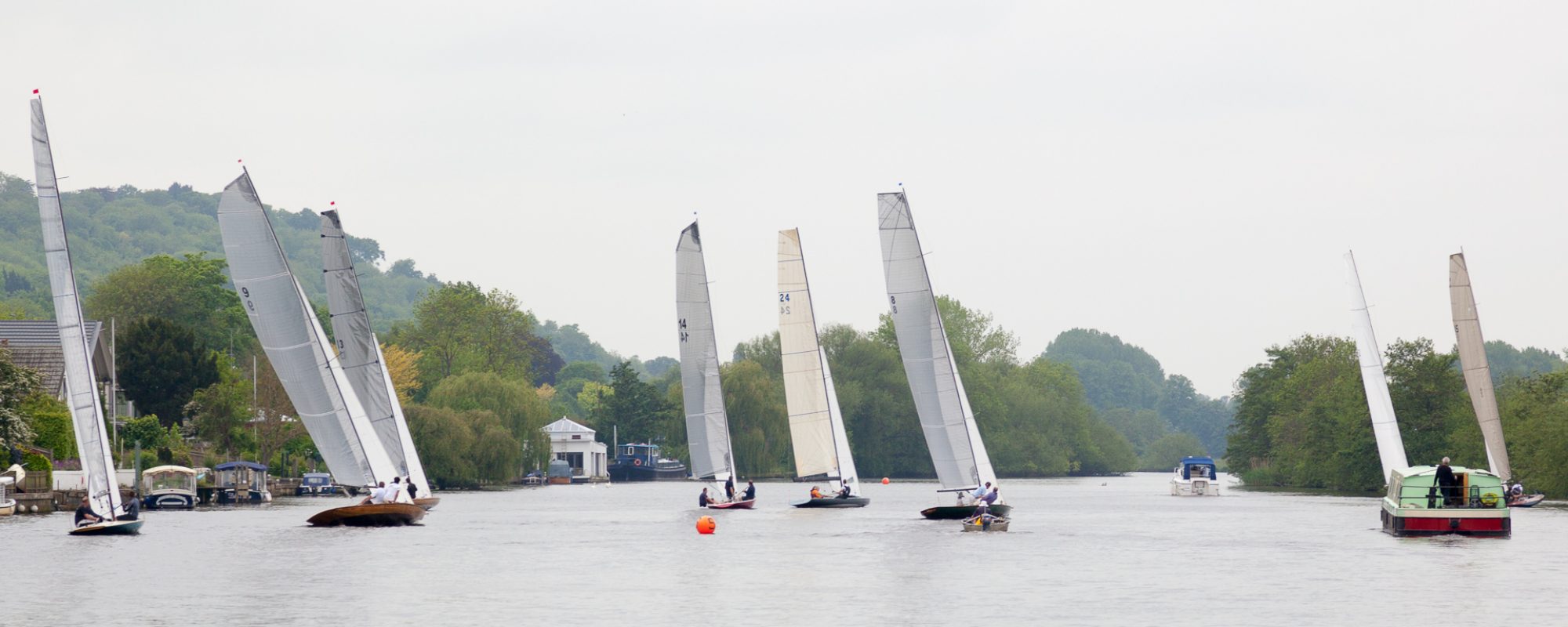
Rater No 17 “Lady Iona”: A Little History
By Brian Hepburn, syndicate member 1980 – 6th May 2008
In the late 1970’s a then club member Peter Dimmer became concerned at the number of wooden Raters consigned to the rafters of the sail shed, the difficulty and cost of maintaining them and the possibility of the class dying out. He and others conceived the idea of building plastic hulled Raters formed from a moulding of the hull of one of the oldest; “Ulva”. To make the cost viable at least four hulls needed ordering. Mustang Yachts on the Isle of Wight gave acceptable quotations in September 1979 and syndicates formed to fund the work. Delivery took place in March 1981, hull costs £2236.75. Sails cost £627.90, mast and rigging £635.47.
We chose the name “Iona” as a beautiful Scottish Island and to honour the boats derivation from “Ulva” another Scottish Island and to make it more feminine we added “Lady”. Tony Penfold the other main syndicate member and I agreed that she would be sailed primarily for fun and enjoyment and fracas be avoided. Shortly after her christening I looked by chance through old club records and found a previous Rater “Iona”, who had won some club silverware – the name a delightful coincidence.
Much frantic work saw the new “plastics” ready for Bourne End Week 1981. Wild winds produced many capsizes resulting in the severe twisting of the new masts, inspected on site by a representative from Holts. They could not be used; Holts were embarrassed by the failure of the design; did not want it reported in sailing magazines, so replaced them stronger and redesigned; free of charge!
On the subject of masts we replaced with a new aluminium mast in August 1994 £1,796 and March1995 carbon fibre £4243.22; nearly seven times the cost of the original – such is the price of progress – but far fewer capsizes. At the end of the 2001 racing season our maintenance inspection showed major structural weakness; so Steve Neal put in new carbon fibre reinforced bulkheads, re-decked and when a pencil would go through it (my face told a lot); a new hog, in all £10,250.86. Early spring and Steve Neal lacked the manpower to get Lady Iona back from his yard. Regretfully I hummed and hawed until one Tuesday evening Paul Browning said “Haven’t you got your boat back yet?”, “No” I replied, rather shameful. “Come on! We’ll get it back this evening” In a trice he had rallied a load of stalwarts into Cora. The enthusiastic mob manhandled her from upside down and lifted her without trolley aid into the water – an evening I remember with laughs, gratitude and Thames Sailing Club camaraderie.
“Lady Iona” earned one second and two thirds in The Queens’ Cup; came first in the Minima Centenary Regatta and has engravings on many Thames Sailing Club cups, due often to shear perseverance.
Three memories:-
- I can not remember the year but we were still using aluminium masts. A story of perseverance. Racing in the Queens’ Cup; leaden skies, some rain and good wind. Within the five minute gun the main halyard snapped. To start officially we crossed the line heading for the shallow shore and careened just above the club house; fixed the mainsail to the top of the mast, a good piece of jury rigging by Tony Penfold. The rest of the fleet out of sight round the corner. A long race so we scrambled back a few places, the wind force increasing. Coming off the bottom mark a great gust capsized Lady Iona in the centre of the river. I was ready to retire. Tony had other ideas. By good fortune we had a crew new to us; aged in their twenties and very strong – John I think. We had on board a long tow line which John swan to the shallow shore where we had careened previously. Swimming, heaving and struggling we towed and beached the capsized Lady Iona, tipped out the water and once more got sailing. Very lonely the river struck us, a grey windy expanse with little in view. We came across much of the fleet capsized by the great squall to realise only four boats left racing. We came past Dainty Two, saved by some excellent and prudent seamanship. Now all that remained was to keep upright and hope to have done enough to have erased the handicap advantage of Dainty Two. By now the wind had dropped; a gun marked our finish. Dainty Two appeared round the bend; we counted the minutes and seconds. Dainty Two crossed the line well outside the handicap so we earned a third and Dainty Two an honourable first (and only) place vintage Rater.
- Another grey day, light winds and a heavy stream to a TSC upstream mark. About eight Raters out. The upstream mark elusive seventy yards away on the first beat in the frail wind. A lot of roll tacking, sail pumping and gradually louder shouts of “Protest! Lady Iona” stayed stationary with her bow wedged in the bank. The shouts of “I am protesting you” turned gradually to laugher and admission of guilt as despite the acknowledged cheating the mark remained elusive so they all agreed to retire to the bar. After they had turned round wind ripples spread downstream from the top mark. We pushed Lady Iona’s bow of the bank into a useful breeze and won a now unchallenged race.
- In my earlier days Bourne End was a full week and held a week later. Mostly this seemed to find far warmed weather. Happy memories of two days on the tow, legless and crew living up to her name and calls and pubs and sunlit picnics and some young ladies body surfing. A morning race took place in idyllic weather, little stream, a gentle breeze so crew wearing shorts, cotton shirts and sun bloc. Upstream from the club off riverbank lay moored a houseboat with flat deck perfect for sunbathing and viewing and is so used by four so comely damsels from our clubs. As the morning grew hotter so their bikinis became topless. Interesting how the tactics of every Rater helm involved a tack off the opposite bank arrow straight on heading to that houseboat! Lady Iona helmsman steered an identical course because… we sailed always for fun and enjoyment.
 Thames A-Rater Association - high performance sailing