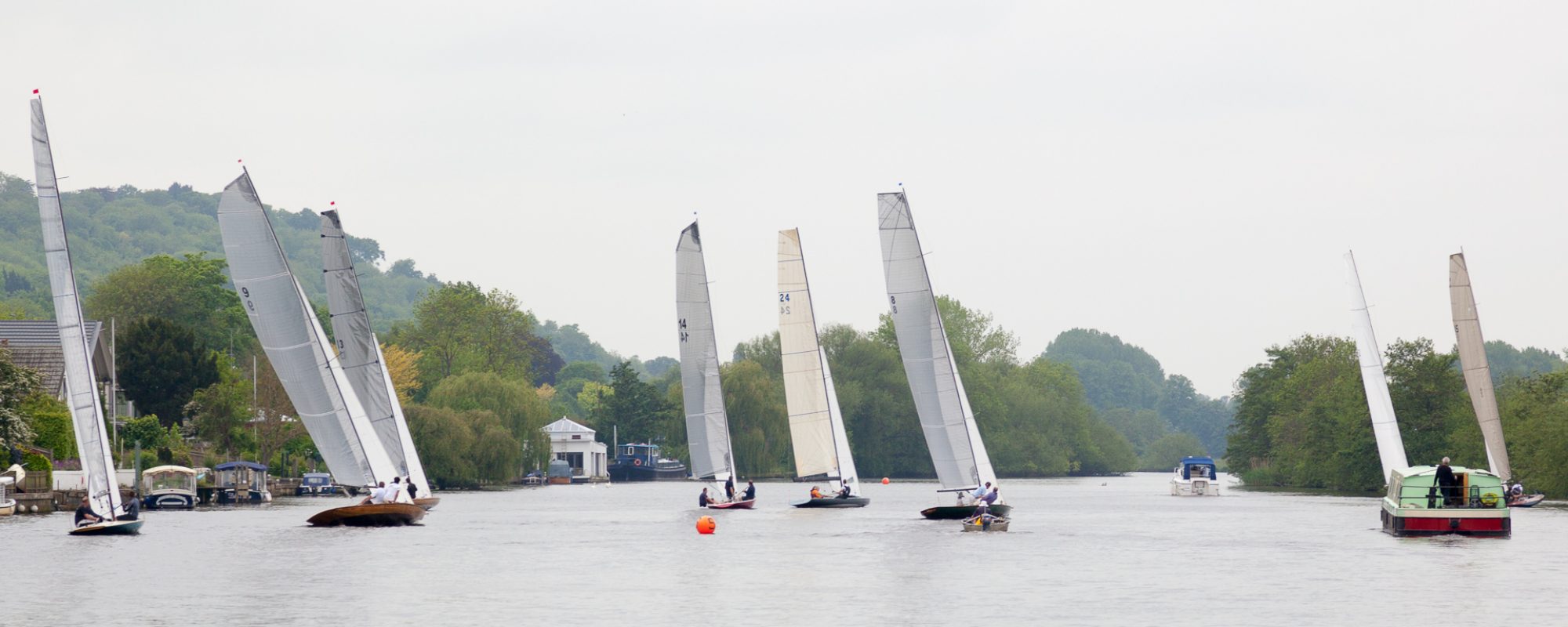
The cost, size and complexity of the boats means the class will always remain small. They’re a specialised river sailing boat and not suited to open waters other than reservoirs. In their native element they are faster than anything else as well as being elegant to look at and huge fun to sail. 140 years on from when they first appeared they continue to flourish.
The Dawn of The Raters
In December 1886 the Yacht Racing Association adopted a new measurement rule which came to be known as the rating rule. It replaced an earlier rule which, by penalising beam, had resulted in yachts – known as plank-on-edge – that were long, narrow and of dubious seaworthiness. From 1887 a yacht’s rating was calculated by multiplying the sail area by the waterline length and dividing by 6,000. No stipulations were made in respect of rig, hull shape, cockpit layout, construction or anything else. On the Thames early boats were lugsail rigged – see photos in clubhouse. Gunter followed in the run up to WW1 and then Bermudan in the 1920s.
The rating rule governed the design of all racing yachts for a decade, but it too had its faults and eventually resulted in lightweight boats with long overhangs which were not suitable for cruising once their racing days were over. On the sea, races were run for ½, 1, 2½, 5, 10, 20 and 40 Raters. The latter were the largest racing class of the day and carried a crew of 11 including a cook and a steward.
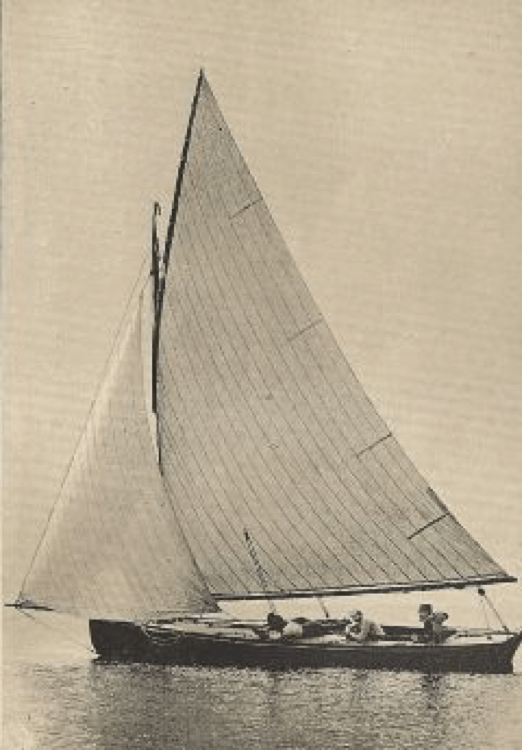
The Babe, 2½ Rater, 1890. Skipper Edward Sycamore. Owner W A Beauclerk
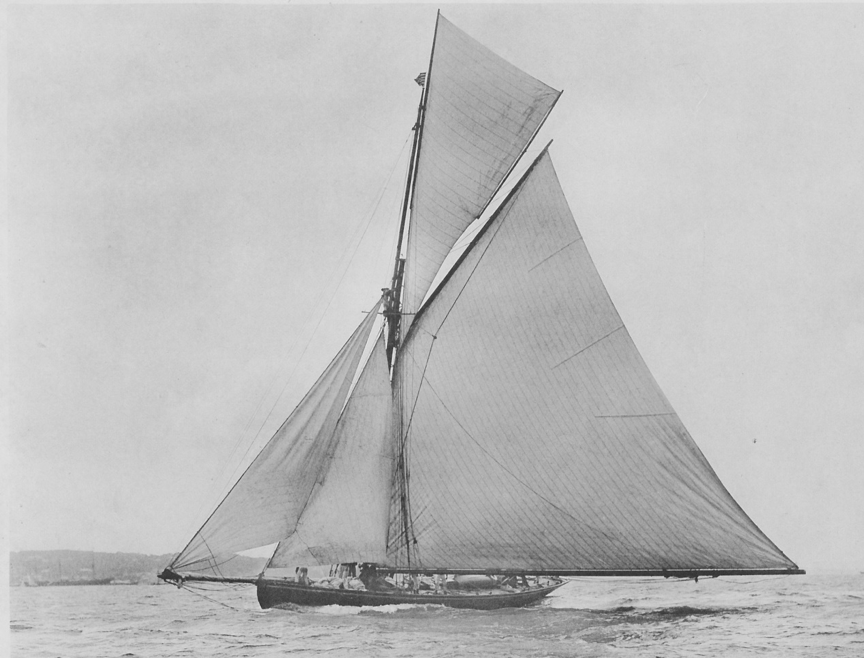 Corsair, 40 Rater, 1893. Skipper Edward Sycamore. Owner Rear Admiral the Hon Victor Montagu.
Although by the mid 1890s the construction of seagoing yachts to the rule came to an end building continued on the Thames. Here racing was under the auspices of the Sailing Boat Association (SBA), founded in 1887, which continued in existence until just after WW2. Early boats were quite large with ratings of up to 1.2 being recorded. Tara by comparison is about .92. Then, as now, handicaps were applied. In 1900 the SBA decreed that any boat with a rating between .75 and 1 with a crew of three should be an A Rater. Boats of .4 to .75 rating with a crew of two were classed as B Raters. Boats in excess of 1 rating were not allowed to race on the river.
B Raters are now virtually extinct although smaller boats, such as Vanessa and Saucy Sally, sailing with a reduced rig would be B Raters. They were killed off by the arrival of more modern designs, such as the International 14, during the inter war years. Even the A Rater suffered from this competition and the class ceased regular sailing at UTSC in the 1920s. Only Scamp, owned by Scott Freeman, remained until the late 1950s and she seldom sailed except in BEW.
There are now twenty three A Raters. Twelve of these are wooden and apart from Dainty Too (built 1922) were all built before WW1. The sail numbers of the wooden boats (1 to 13) are haphazard and do not reflect age or build sequence. Those from 14 onwards do. In the early 1980s it was recognised that the class might die unless new boats were built in GRP. A mould was taken from the hull of the oldest boat (Ulva built in 1898) and used to build nine GRP hulls (14-22) in the 1980s and 1990s.
More recently a mould has been made using the lines of Scamp which were published in Yachting Monthly. Adventurer is so far the only boat built from this mould. The hull shape is quite different from that of Ulva reflecting the wide variety of hull designs in the wooden fleet. Class rules require that any new boat should conform closely to the hull shape of an existing one.
Rater sailing at Thames SC, where the bulk of the fleet has always been based, is healthy with up to eight boats racing regularly, but we struggle to get a good turnout at Bourne End despite having six boats, more than a quarter of the fleet, based there. A typical turn out for BEW is twelve to fourteen boats but on one occasion we managed sixteen which was quite exciting on the start line! Apart from the boats on the Thames there is Bonito (22) on Wroxham Broad and Champagne (21), formerly a UTSC boat, on the Trent.
Of the boats which survived the 1950s only Viva no longer exists. She was broken up in the 1990s having been sold off the river. Saucy Sally, Estelle, Surf and My Lady Dainty are laid up at Thames awaiting major refurbishment. Their future is uncertain both because of the expensive work needed and because the boatshed at Thames is about to be redeveloped and may not in future have storage for these old hulls.
The main regatta for the class is Bourne End Week which was started in 1887 to celebrate Queen Victoria’s golden jubilee. Initially a different club ran the racing each day but now it is run by UTSC. Other open meetings are held at Thames SC for the China Bowl (1903) and the Tamesis Club for the Braganza Bowl (1904) and Yeats cup. The main trophy is the Queen’s Cup presented to UTSC in 1893 by Queen Victoria. It is thought to be the only Royal Cup presented to an inland club; to a sailing club not a yacht club; and for perpetual rather than one off completion. The second most important BEW trophy is the Thames Champion Cup which dates from 1887. Initially it was a single match race sailed at Surbiton but moved to Bourne End in 1890 also as a single match trophy. It became the series trophy for BEW in 1900. A newly arrived trophy for 2018 is the Ruby Salver which goes to the highest placed boat in the Thames Champion Cup which was not place first, second or third in any race. It was originally won by Ruby on the Monday of the second BEW in 1888 and is the oldest known BEW trophy.
The cost, size and complexity of the boats means the class will always remain small. They’re a specialised river sailing boat and not suited to open waters other than reservoirs. In their native element they are faster than anything else as well as being elegant to look at and huge fun to sail. 140 years on from when they first appeared they continue to flourish.
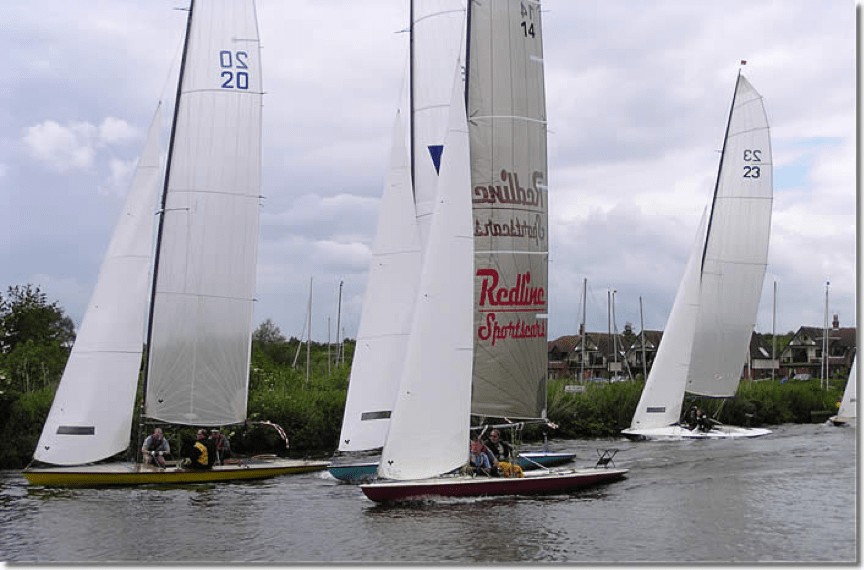 Raters leaving Horning in the 3R race. Lady Jane, Osprey, Spindrift, Tara – Photo Horning SC
 Thames A-Rater Association - high performance sailing