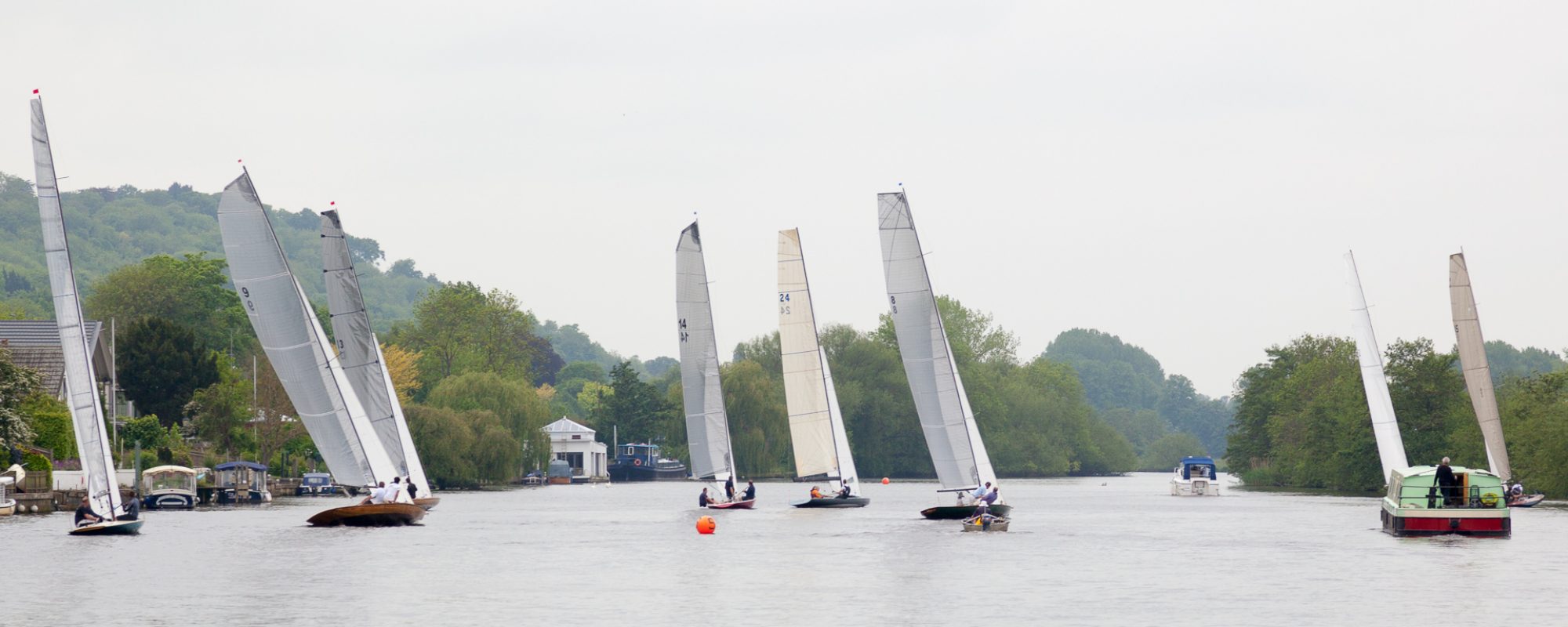
When Denis Peters died the club not just lost one of the finest gentlemen any of us will ever meet, but one of our last living links to the club’s heyday, to a time where the older members at least were recognisably the same kind of men who created TSC in 1870, and who sailed the same kinds of boat. Of course their time was passing, as surely as the 14s and National 12s killed the B Raters and gigs, leaving just the A Raters, fading memories and oh so evocative photos.
Dennis joined in the last gasp of one era, and witnessed the old ways before they were swept away by war and social change. He in turn grew old with the club he loved, passing on his warmth, wisdom, humour and memories. I was lucky enough to catch some of those memories in an interview….
The 18 year old Denis joined TSC in 1932, following his friend Ralph Coates, who sailed a gig, (an open 12-14 sailing dinghy) beginning a 74 year association with the club. Getting membership in those days is a reminder that the past is not always something to be totally nostalgic about. It was, he recalled, a rich man’s sport, and not just that, the right kind of money. Thames was a club for men in the professions rather than just having any old job. Being in trade was definitely not on. If you were a grocer you were “discouraged, or might have been blackballed.” Two blackballs, anonymous naturally, were enough and such things happened. The custom was that “people who sought to join were brought before the committee and given the once over to see if they would fit in.” The box for the balls is still in the dining area of the clubhouse.
It was also still a man’s world, and women were not entitled to be full members of the club. Some did sail, Enid Turketine was a particularly formidable example, but they were certainly not allowed in the bar, “Along the balcony there was in fact a little gate, closed except to full members of the club, and certainly barring the ladies and underage people.”
None of this was a bar to Denis, the young professional man, but youth was its own barrier, “I was one of many juniors who if lucky were allocated to a rater.” As he recalled, “The skippers were gentlemen…who would step aboard their raters with reefer jackets on, wing collars and a yachting cap, and expect the young juniors to have the boats all ready for them to sail, and then having finished the race they would step ashore and say to the crew ‘get her unrigged chaps and I’ll see you in the bar in half an hour’s time.’” But there was no resentment on the part of the juniors says Denis – they were just pleased to be part of a gentleman’s club.
The racing then was on a Saturday afternoon, and everyone arrived at lunchtime, “The gentleman skippers assembled in the bar drinking large pink gins or whiskies while the young fellows got the boat ready.” At the end the process was reversed, and with the boat put to bed the juniors, “With trepidation descended upon the bar to be asked what they wanted to drink by their skipper.”
Of course the compliment had to be returned, something that caused young professionals at the impoverished start of the careers more trepidation, but, “The skippers would ask for half a bitter when drinking large scotches because they didn’t want to embarrass you by asking you to pay out a lot of money.”
In those times Denis recalled, “Asking for spirits and not bitter was beyond the pale – you didn’t drink spirits as a young man. After racing us juniors stayed for a drink or two and were then expected to depart, leaving the seniors to their devices.”
He also had fond memories of the enormous teas, “After racing we had the most beautiful teas. I can see loaves of bread now, which were always great loaves with wads of butter, and always kipper or bloater paste to go with – I can almost smell it to this day.”
But for all the pink gins and enormous teas the racing was very competitive. Then as now,” The racing was very keen and afterwards skippers would have the most enormous discussions as to what went on.”
Some things weren’t the same though, “Looking back the skippers never looked dishevelled – I think the crew did all the work. If you look back at pictures the skippers wore ties and collars and crews looked more like tramps.”
He remembered the crews and ladies wore waterproof ‘half raters’ to their knees – he said they looked rather like rubber knickers. Each boat also had to carry a lifebuoy, while boats that capsized sank, although then, as now, a crew that was really slick could save the boat by getting onto the centreplate, and righting the boat as long as the cotton mainsail did not get wet.
Of course those cotton mainsails limited the speed of the boats, although the Raters were still very quick by the standards of the day. Denis felt the helms were not as skilled as today, “The general standard of sailing has improved dramatically.” But that didn’t mean they weren’t intensely competitive, which also stretched to a little gamesmanship. This included winding up the wire inside the boat that stretched from bow to stern. This not only prevented hogging (the sagging of the boat at the ends) but when, at measuring time, they were wound up even more, which reduced the waterline length and so improved the handicap.
Denis had particular memories of one of the club’s great characters, the American Beecher Moore, who sailed Vagabond and was later a partner of boat builder and designer Jack Holt. “Beecher was always thinking of something new, when he put on a sliding seat people raised their eyes in wonder,” Denis recalled, “He was quite exceptional – the personification of sailing and always trying to be one step ahead.”
Boat maintenance was also rather easier for the wealthy skippers than some of today’s cash-strapped syndicates. Most of the boats were kept in good condition as paid hands were hired to do the work during the season and local boatyards did the major work after they were laid up, “Gentlemen didn’t do that kind of work,” said Denis. The club even had its own boatman, Harris, “He was the sort of boatman you would expect, a grizzled ex-Merchant Navy man.”
But after World War Two Denis remembered how the formerly rich man’s sport became increasingly available to everyone, “Sailing became a universal sport with the rise of dinghies.” There was the Merlin Rocket (part developed by Beecher Moore, the former owner of Vagabond), the Firefly and all Jack Holt’s plywood marvels such as the Cadet, Solo and Enterprise. Along with this came social change, notably when ladies finally became full members and were allowed in the bar, “One old member said, ‘Now see your bar profits go down.’, but in fact they doubled.” It has to be said that TSC was one of the last clubs on the river to finally give the ladies equality.
Even Bourne End changed although it was still the social and sailing peak of the rater year. When Denis first went BEW was ‘the inland Cowes’ attracting Olympic class sailors and top level social events, with the Queen’s Cup supper still very much the highlight, “It was a great occasion and competitive sport in a very nice atmosphere – there was a real dignity about the place in those days.”
Not too dignified though, when he first went he shared a bell tent on the club lawn with others because they didn’t have the money for anything more. The skippers used to stay in the Quarry Hotel on the opposite bank. Children were not really welcome, but after the war he saw what he called a cultural revolution as families were encouraged not discouraged.
But although Denis had so many happy memories of the old days, he never downplayed the present. Times may have changed he said, but the attraction of river racing, especially in Raters, did not, and neither did the atmosphere of friendship. He also remembered something Beecher Moore, who was active in the club in the thirties, had said, “I recall him coming down many years later and sailing a Rater and coming ashore and saying, “There’s nothing like it is there?” and he’d sailed everything.”
And neither was there anyone quite like Denis Peters.
 Thames A-Rater Association - high performance sailing